Information Gain: How Unique Data Builds Your Brand’s Authority in AI

Table of contents

Try our new
Local SEO tool
Manage and track visibility of your
Google Business Profiles
In local SEO, the winner is increasingly not the one who publishes yet another “generic guide,” but the one who adds something new to the information ecosystem. That’s exactly what Information Gain means today: genuine, new value in content - your own observations, market data, insights from monitoring, and concrete examples from local search results. In practice, these are the kinds of pages AI is more likely to cite, because they aren’t a copy of what already exists.
This matters especially now that people look for local businesses not only in Google, but also through generative tools. Google explicitly explains that AI Overviews provide summaries with links to sources, and its guidance for site owners emphasizes that content should still follow solid SEO fundamentals and be genuinely useful to users. Meanwhile, Gemini and ChatGPT surface sources or links as well - so “being citable” is becoming a real goal of local content [1][2][3][4].
First-party data from local SEO monitoring: the strongest form of Information Gain
The biggest advantage today isn’t writing style - it’s data your competitors don’t have. That’s why first-party, aggregated statistics from local SEO monitoring are so valuable.
At Rating Captain, the platform operates at scale: it supports over 120k listings, runs more than 50k rank scans per day, and monitors over 300k keywords. These numbers matter not because they “look good,” but because they enable content built on trends rather than guesses [5].
For blog readers, the benefit is straightforward: instead of publishing yet another generic tip like “complete your Google profile,” you can show concrete local phenomena - for example, how keyword visibility changes across different neighborhoods, or which types of actions stabilize rankings faster. That kind of material has higher educational value and a higher chance of being cited by AI systems, because it adds something new to the topic.
Heatmaps and Local SERP Map: insights you won’t see in a standard rank tracker
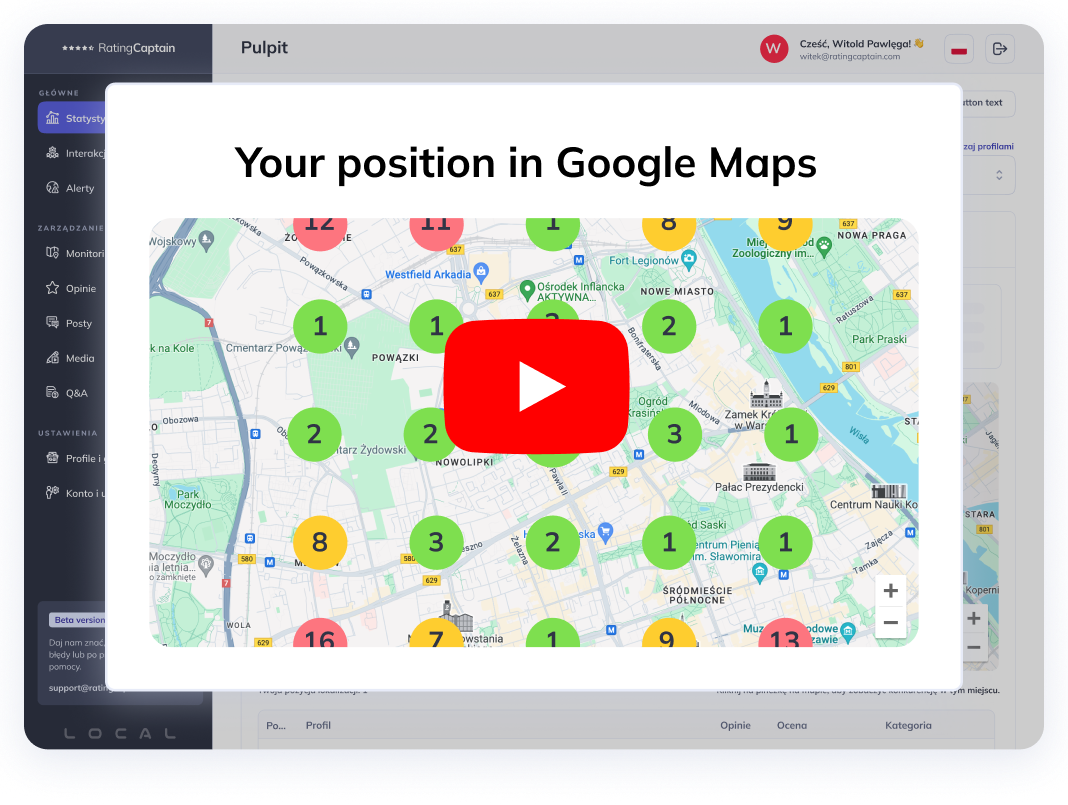
A second source of Information Gain is visualization - especially heatmaps of local results. A standard rank check from a single point doesn’t show the full picture, because local visibility changes depending on where the user is.
In Rating Captain, Local SERP Map and map ranking reports show visibility across grid points, and the knowledge base confirms you can use a custom grid with up to 81 measurement points. This is where you can spot micro-patterns that an “average position” won’t reveal - classic ranking gaps in specific parts of a city [5][6].
This kind of content is valuable to blog readers because it turns theory into practice. Instead of writing “work on local SEO,” you can show how to interpret red zones on a map, how to compare them with competitor data, and how to plan actions only where the business is actually losing visibility.
AI Post Writer and “RAG-ready” content: turning data into chunks AI can understand
Knowledge alone isn’t enough if it isn’t presented well. In the GEO era, format matters too, because generative models retrieve and summarize content in short fragments.
The advantage appears when unique monitoring data is consistently turned into short, concrete updates for a Business Profile and blog content. In Rating Captain, AI Post Writer supports creating keyword-driven posts and maintaining profile activity for one or many locations, and the entire system is built around local SEO and data from Google Search, Google Maps, and GBP [5][7].
This makes sense for local businesses because it’s not about “writing for AI,” but about publishing content that is readable for both people and search systems. Shorter, specific paragraphs with local context, a service name, and a service area match user intent more directly - and more easily become part of a generative answer.
Freshness in GEO: why up-to-date data gets cited by AI more often
In local content marketing, the winner is often not the most comprehensive article, but the most current one. This is especially important in GEO, where AI systems often prefer newer sources than classic organic results.
AI search market analyses suggest that cited content tends to be, on average, fresher than results in traditional SERPs - and in some cases the effect is very pronounced. For local businesses and agencies, the takeaway is practical: it’s not enough to have one great article “once” - you need to refresh it regularly and add new observations [8].
That’s why daily rank tracking in Rating Captain has direct editorial value. Daily Rank Tracker isn’t only a tool for monitoring positions - it’s also a source of topics to publish. If you see a visibility shift in a specific neighborhood, a new keyword trend, or a drop after an update, you can quickly document it in content. Then your brand becomes a source of first commentary, not just another repeater of generic advice [5][7].
Summary: Information Gain as an advantage in GEO and AI citations
The most important shift in 2026 is simple: AI doesn’t need more generic content. It needs specific, fresh, and credible information. For local brands, that means building an advantage through first-party data, local observations, and regular publishing of insights from monitoring.
That’s why it’s worth treating Information Gain as part of your GEO strategy - not as a trendy buzzword, but as a practical content filter: does this piece add something new, or is it just repeating what’s already online?
If the answer is “it adds something,” the chances go up that the content will be read, linked, and cited.
FAQ: Information Gain in local SEO and GEO
What exactly is Information Gain in local SEO?
It’s additional informational value in content that doesn’t exist elsewhere. In practice, that means your own observations from rank monitoring, heatmap data, and local conclusions instead of generic tips.
Can a small business also create Information Gain content?
Yes. You don’t need to publish big reports. It’s enough to regularly describe real visibility changes, seasonal trends, or neighborhood differences based on your own monitoring data.
How do you start implementing this approach in practice?
The simplest way is to begin with daily rank monitoring, a visibility map, and short publications based on concrete observations. Data first, then the insight, and finally a recommendation for the customer or user.
References
[1] Google Search Central, AI features and your website.
[2] Google Search Help, Find information in faster & easier ways with AI Overviews in Google Search.
[3] Gemini Apps Help, View related sources & double-check responses from Gemini Apps.
[4] OpenAI Help Center, ChatGPT search; Retrieval Augmented Generation (RAG) and Semantic Search for GPTs.
[5] Rating Captain, Local SEO Tool product page / product materials.
[6] Rating Captain Knowledge Base, monitoring grid FAQ (custom grid, up to 81 points).
[7] Google Business Profile Help, Tips to improve your local ranking on Google.
[8] Passionfruit, Why AI Citations Come from Top 10 Rankings | SERP Data Analysis.
Share this article
Short description (you can edit)
Tip: you can edit the description before sharing on WhatsApp or adding as Facebook quote
Author of the post
Local SEO Specialist
Julia is responsible for local SEO activities and supports Rating Captain’s brand communication. She optimizes Google listings and co-creates strategies that enhance companies’ visibility in search results. She is passionate about consumer behavior and the latest trends in local digital marketing.
Please rate this article
Try our new
Local SEO tool
Manage and track visibility of your
Google Business Profiles