GEO: Wie rankt man ein lokales Unternehmen in ChatGPT, Gemini und AI Overviews?

Table of contents

Blase Konkurrenz mit Google Maps weg
Verwalten und verfolgen Sie die Sichtbarkeit Ihrer Google Business-Profile
In 2026, local brand visibility doesn’t end with Google Maps. More and more often, a user asks a question in ChatGPT or Gemini, or gets a ready-made answer in AI Overviews - and only then clicks through to a specific business. That changes the rules of the game. In classic SEO, the main battle was for position. In GEO, what matters is whether your brand appears in generative answers as a credible recommendation [1][2][3].
That doesn’t mean local SEO is no longer important - quite the opposite. GEO is built on the same foundations, but it extends them with a new goal: making your brand present in AI-generated answers.
1. GEO and “information gain”: valuable answers instead of “more keywords”
The most common mistake in approaching GEO is treating it like old SEO with a new name. Generative models don’t “reward” keyword volume on its own. They perform much better with content that adds real informational value: it answers precisely, includes local context, and avoids generic filler.
In practice, for a local business, this means a simple shift in mindset. Instead of publishing yet another “Why choose our service” article, it’s better to create content that answers real questions from customers in your area, for example:
-
when it’s best to book the service in a specific neighborhood,
-
which issues most commonly occur locally,
-
how the scope of the service differs between downtown and the outskirts,
-
what the most common customer mistakes are before an appointment.
This kind of “information gain” increases the chances that an AI model will treat your brand as a useful source - not just another page with a generic service description. In GEO, specificity, local context, and regular content updates win.
2. “RAG-ready” content and AI Post Writer: a model-friendly format
Search engines and generative assistants increasingly operate with a logic similar to RAG (Retrieval-Augmented Generation). That means the model first retrieves information from available sources and then builds an answer based on them [4]. For a local business, this has a very practical implication: your content must be written so the model can easily “pull it out” and understand it.
That’s why GEO tends to work best with content that is:
-
short,
-
specific,
-
structured into logical sections,
-
with a clear heading and one answer per paragraph.

This is where AI Post Writer in Rating Captain comes in. The tool helps create Google Business Profile posts in a format that’s friendly for language models - concise, well-structured, and grounded in local context [5][6]. In practice, a structure like an Atomic Answer works best:
-
a headline with a specific question or topic,
-
a 40-60 word answer,
-
a local detail (neighborhood, street, service area).
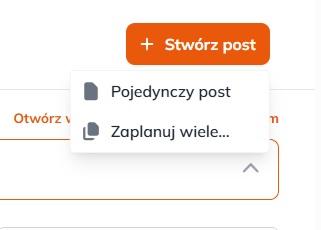
This format increases the likelihood that AI Overviews or a generative assistant will use that exact passage as a “chunk” in its answer.
That matters, because in GEO it’s not the sheer length of the text that counts. What counts is whether the content can be easily quoted and correctly interpreted.
3. Share of AI Voice: a GEO KPI alongside Google Maps rankings
In 2026, a strong position in Google Maps alone is no longer enough as the primary success metric. A brand can rank highly in the Local Pack and still not appear in answers from ChatGPT, Gemini, or AI Overviews.
That’s why it’s worth introducing an additional KPI: Share of AI Voice - your brand’s share of generative mentions compared to competitors.
Formula:
Share of AI Voice = (mentions of your brand in AI / total mentions of the category in AI) × 100
This metric brings structure to GEO analysis because it measures not only “are we ranking high,” but also “does AI mention us when a user asks for the best company nearby?”
The focus of this approach aligns well with what Local Rank Tracker in Rating Captain already does:
-
tracks local rankings,
-
shows visibility on a map,
-
monitors competitors,
-
provides time-based change data [5][6].
On that basis, you can build broader monitoring of your brand’s presence in generative answers.
4. Single Source of Truth: consistent NAP and profile data as the foundation of GEO
AI models don’t trust a brand that looks inconsistent. If one source lists different opening hours, another has a different phone number, and elsewhere the address is outdated, the brand becomes less credible as an entity.
This isn’t just theory. For years, Google has emphasized the importance of complete and accurate Business Profile information, and local ranking still rests on three pillars: relevance, distance, and prominence [7]. In GEO, the same logic is even stronger, because generative models try to merge information from multiple sources at once.
That’s why maintaining a Single Source of Truth - one consistent set of NAP data - is so important:
-
Name (business name),
-
Address (address),
-
Phone (phone number).
In practice, features like 24/7 Listing Protection and Real-time Alerts in Rating Captain are a GEO foundation - not an administrative extra. They help you quickly catch changes to the listing and maintain data consistency, which is a signal of stability and trustworthiness for AI [5][6].
5. Heatmaps and granular relevance: visibility neighborhood by neighborhood
One of the strongest levers in local GEO today is granular relevance - relevance at the micro-area level. It’s no longer just about whether the brand is visible “in Wrocław.” What matters more is whether it will be recommended to a user who is standing two streets away.
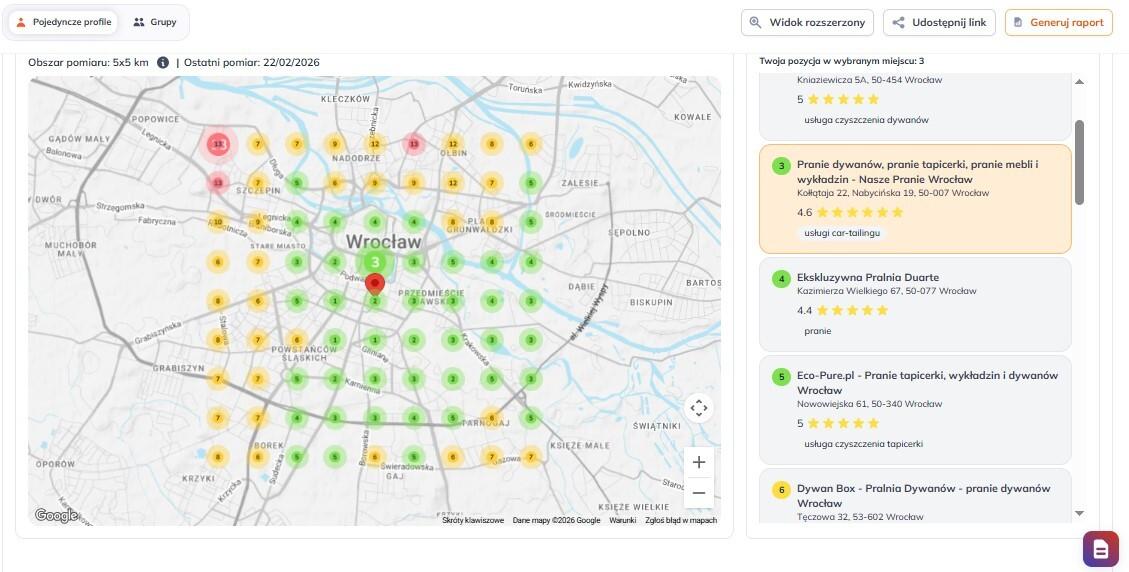
That’s exactly why heatmaps and Local SERP Map matter so much. They show how a brand’s visibility changes across different points in a city and where “ranking gaps” appear - places where the business performs poorly [6][8].
In Rating Captain, the heatmap works as a visibility grid that lets you analyze local SERPs point by point. Thanks to this, you can:
-
identify neighborhoods where the brand is being overlooked,
-
compare those areas with competitors,
-
match keywords and content to specific micro-locations,
-
check whether GBP changes improve visibility in a given area [5][6][8].
This directly supports GEO, because AI models rely on local signals and context. If a brand is strong only near its headquarters but weak in other parts of its service area, generative answers may point to competitors more often as well.
Rating Captain expert tip
Karol Bocheński (Rating Captain): “In the GEO era, the winner isn’t the one who crams in more keywords - it’s the one who builds a consistent entity: a brand whose data, context, and activity are unambiguous for AI.”
In the GEO era, you no longer optimize only for keywords. You optimize for an entity: a recognizable and consistent local brand. That’s why your Google Business Profile should be active and updated regularly - ideally at least 2–3 posts per week. Using AI Post Writer, it’s easier to keep that cadence while building natural local context that strengthens your brand’s topical authority [5][7].
How to implement GEO locally step by step?
To keep this from staying theory, it’s worth treating GEO as a process:
-
Clean up NAP data and opening hours
Consistency first-only then content and promotion [7]. -
Start daily monitoring of local rankings
Without it, you can’t evaluate whether your map visibility is improving in the right direction [5][6]. -
Check the heatmap and find ranking gaps
This shows where the brand is being overlooked, neighborhood by neighborhood [6][8]. -
Publish short, local posts using the Atomic Answer structure
AI can more easily reuse such a fragment in an answer [4][5]. -
Track Share of AI Voice
Treat it as a KPI alongside classic rankings.
Summary: Local GEO in 2026 - what to do so AI recommends your business
GEO for local businesses is not about “writing for AI” in isolation from local SEO. It’s an extension of proven practices with a new layer: brand presence in generative answers.
First, take care of the fundamentals: consistent data, an active profile, and map visibility. Then add what makes the difference in 2026: RAG-ready content, heatmaps that demonstrate granular relevance, and Share of AI Voice monitoring.
This combination helps you build visibility not only in Google Maps, but also in ChatGPT, Gemini, and AI Overviews.
FAQ: GEO for local businesses
Does GEO replace local SEO?
No. GEO expands local SEO. You still need to work on your Google listing, rankings, and reviews, but it’s also worth monitoring brand presence in AI answers.
Does AI Post Writer really matter for visibility in AI?
Yes - if it helps you create short, specific, local content in a format that models can easily use. In GEO, content structure matters a lot, not just the keyword itself [4][5].
What matters more in GEO: the heatmap or the keyword position?
Both, but the heatmap gives a broader picture. It shows where the brand is actually visible and where it has ranking gaps that later also affect presence in generative answers [6][8].
References
[1] OpenAI Help Center, ChatGPT search.
[2] Google Gemini Help, View related sources & double-check responses from Gemini Apps.
[3] Google Search Central, AI features and your website.
[4] OpenAI Help Center, Retrieval Augmented Generation (RAG) and Semantic Search for GPTs.
[5] Rating Captain, Local SEO Tool.
[6] Rating Captain, Rank Tracker Reports / Local SERP Map.
[7] Google Business Profile Help, Tips to improve your local ranking on Google.
[8] Rating Captain Knowledge Base, Rating Captain Local - Knowledge Base.
Share this article
Short description (you can edit)
Tip: you can edit the description before sharing on WhatsApp or adding as Facebook quote
Author of the post
Local SEO Specialist
Julia is responsible for local SEO activities and supports Rating Captain’s brand communication. She optimizes Google listings and co-creates strategies that enhance companies’ visibility in search results. She is passionate about consumer behavior and the latest trends in local digital marketing.
Please rate this article
Blase Konkurrenz mit Google Maps weg
Verwalten und verfolgen Sie die Sichtbarkeit Ihrer Google Business-Profile